
Business expansion from UAE to GCC such as Qatar, Kuwait, Saudi Arabia, Oman and Bahrain often appear to be one natural next step.
However, mostly companies quickly realize that achieving success in the UAE is not an automated feature but translate across neighboring gulf markets.
Despite geographical proximity and cultural similarities, the UAE to GCC expansion challenges come with operational regulatory and market-specific complexities.
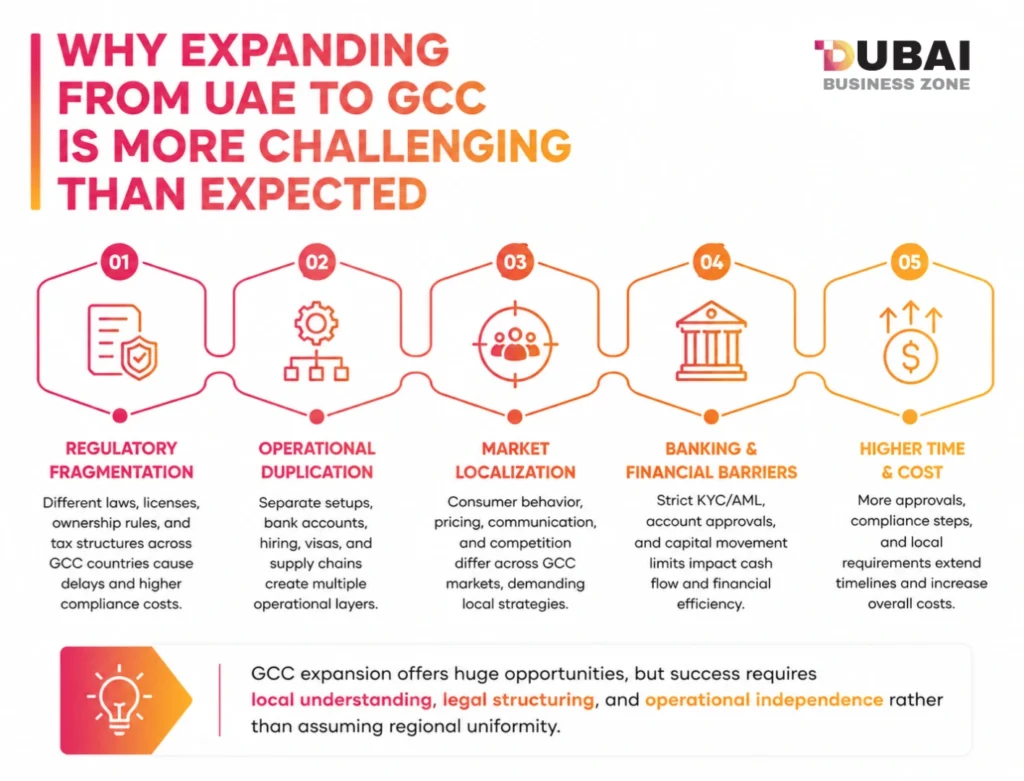
Regulatory fragmentation
One of the biggest UAE to GCC expansion challenges is shortage of unified regulations across GCC Nations. Each of these nations has its own:
- Foreign ownership rules.
- Licensing system.
- Tax structure and compliance requirements.
- Commercial agency laws.
For example, a business structure accepted in Dubai demands local partnership or re-licensing in Kuwait or Saudi Arabia. This creates additional cost, delays and legal complexity.
Operational duplication
Different from UAE operations, GCC expansion often demands setting up separate operational entities in each country.
This leads to:
- Multiple approvals and registrations.
- Different banking relationships.
- Country specific visa and hiring system.
- Independent supply chain adjustment.
Note: UAE businesses mostly end up running multiple semi-independent operations rather than a unified GCC market.
Market localization pressure
Consumer behaviour in the GCC countries is more different than the expectations. Marketing strategies working in Dubai may not perform in Doha or Riyadh.
Key differences comprise:
- Language and communication tone.
- Brand trust factors.
- Pricing sensitivity.
- Local competitor dominance.
Note: Companies require heavy investment for localization instead of simple market replication.
Banking and financial barriers
Cross border banking in GCC is not seamless. Businesses may suffer:
- Strict onboarding for new GCC bank accounts.
- Higher compliance check including AML and KYC.
- Restrictions of capital movement in some jurisdictions.
Note: This impacts cash flow efficiency in the expansion phase.
Conclusion
On one hand GCC markets provide strong growth opportunities, the UAE businesses majorly underestimate structured differences between such economies.
Successful expansion demands legal restructuring, localized strategy and operational independence instead of regional uniformity.
If you are also planning for your UAE business to expand in the GCC and experiencing challenges then connect with us!
Frequently Asked Questions (FAQs)
Why are there UAE to GCC expansion challenges?
UAE to GCC expansion challenges is due to compliance requirements, licensing system and regulations being totally different in the UAE and GCC countries.
Is it necessary to have a local partner in a GCC country for business expansion?
Local sponsorship or partnership are required for some sectors in the GCC countries due to legal complexities.
Is it permissible to use UAE company licenses in GCC countries?
No, most of the GCC countries strictly require separate licensing for business operations. Hence, UAE company license is not acceptable in GCC.
What is the biggest hidden cost in GCC expansion?
Compliance setup and operational duplication cost is the major hidden charge in multiple jurisdictions in GCC expansion.
Is GCC expansion still profitable?
Yes, GCC expansion is profitable when backed safely by regulatory planning and proper localization.





No comment yet, add your voice below!